“Girls, can you run outside and pick some blueberries for the pancakes?”
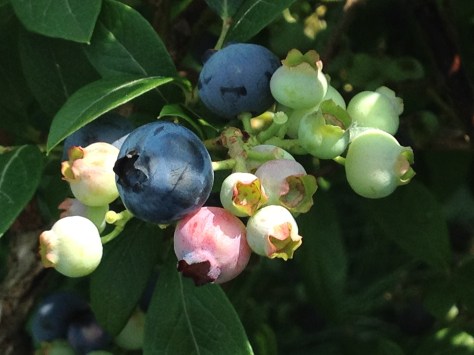
was a question common in our house each June and July Sunday. We would grab a cup and head out to the woods, not the garden, the woods, to pick as many blueberries as the cups would hold, presenting them proudly to mom and dad who were in the kitchen whipping up pancake batter while we stalked the wild berries. If I remember correctly, it was “2 for the cup one for me”, or maybe the other way around. I think about this during a recent visit to western Maine as I squat down to examine small blueberry bushes, with diminutive fruit on them. These are similar to those we harvested beneath the oaks and pines in NJ but are a far cry from the behemoth berries I picked a week ago from a friends farm in Northern NJ.
Perhaps you read the Betty Smith novel A Tree Grows in Brooklyn. {{Spoiler alert}} The tree in the story was an Ailanthus altissima or Tree of Heaven. This tree is known for its ability to thrive in even the harshest of conditions, hence its use as a metaphor for the strength and tenacity of the main character in the book.
“There’s a tree that grows in Brooklyn. Some people call it the Tree of Heaven. No matter where its seed falls, it makes a tree which struggles to reach the sky. It grows in boarded-up lots and out of neglected rubbish heaps. It grows up out of cellar gratings. It is the only tree that grows out of cement. It grows lushly…survives without sun, water, and seemingly without earth. It should be considered beautiful except that there are too many of it.” Betty Smith, A Tree Grows in Brooklyn
The “ghetto palm” (as my inner-city high school interns once described it to me) has become a bit too successful dominating roadsides and vacant lots in all but 6 of the states. Introduced from China as an ornamental plant Ailanthus was planted widely throughout the Northeast in the first half of the century. It fell out of favor with the horticultural crowd but despite its lack of popularity continued to insert itself into devoid and neglected areas of our landscape. In his book Wild Urban Plants of the Northeast Peter Del Tredici asks us to take a different look at these weed plants colonizing waste spaces. He suggests that these “weedy” and “spontaneous” plants benefit the cities by creating forests and the ecological benefits associated with forests, at no cost to the residents. Hmmm. Del Tredici says these are as important part of the urban landscape as the native plants restricted to protected natural areas and the highly maintained cultivated gardens on display throughout the city.
I am still digesting this point of view as it flies in the face of everything familiar to me. While I appreciate the sentiment, science and statistics, it is still hard for me to promote the embrace of invasive, weedy plant species to the detriment of native plants and the wildlife they support. As I continue to consider and explore this topic, I visit those highly manicured cultivated garden spaces that are also an important part of the fabric of a city. This trip takes me to Brooklyn.
Frequently my lead foot (it’s genetic I swear!) and my want to enjoy every plant around me are at odds. At my speeds, you have to have a pretty impressive display to catch my eye! Such was the case with this stunner. I zoomed past it, noticing a flash of blue as I hurried down the back road I had opted for over highway travel. I know, what’s the point of taking back roads if I am just going to fly past all the scenery at warp speed? I don’t have an answer for you.
I continued on a little ways but that blue flash was really nagging me. I slowed down, because at Mach 10, you can’t stop on a dime in case you see another batch of beauty, planning to stop at the next patch I saw. But I only saw one plant here and one there, nothing like the spot of blue that managed to pierce the blur of trees and shrubs that was my adventure home. As is often the case with us speeders, U-Turn it is! I swung around, backtracking, more slowly this time, to get a closer look at this mystery flower.
Ahh the Ladybug…Everyone’s Favorite Carnivorous Beetle
Over the past couple of weeks I have been noticing the insect life on the plants near me. So many times I interact with people interested in gardening for the beauty of the flowers and the value of vegetables for their dinner table. Little do they think about the value of the fruits of our garden to the smallest residents, the insects. Rarely, when they consider their newest plant for their garden do they consider the beauty of the bloom or the fragrance of the flower is meant to attract insects, and just happens to be appealing to us as well.
People get frustrated when caterpillars chew holes in leaves, when bees surround the flowers planted near walkways. But that is the purpose of the flowers. They are just doing their job! The same can be said for the insects. I run into students when I am teaching expressing grave concern regarding the bugs in their yard, asking what they can do to get rid of them. “Pave your yard“, is my internal answer. Not much thrives on asphalt. Being an educator, my actual answer is an explanation of the insect/plant connection and ultimately the insect/human connection. You know, how without insects, our lives would be much much harder. Really, you can’t have beautiful flowers without the bugs that go along with them.
One of my favorite plants is flowering in my yard right now. I love this plant. It is bold, in your face and it passes the multiple seasons of interest test. Every time I see this bloom I am taken back to a forest in Mississippi. My sister and I were on our way back from a road trip to Louisiana, camping the whole time. We stopped in a state park along the Natchez Trace Parkway to take in the sights and stretch our legs following a short hiking trail that seemed made for just such a purpose. We stuck our heads through holes in large trees taking ‘selfies’ before it was the thing to do, watched new-to-us very large spiders make their way along handrails we dared not touch. Suddenly I stop and utter a “do you see that?!” from under the hand clasped over my mouth. I am that person. I get so excited when I see plants I have only known in landscapes thriving in the wild, where they have not been planted where they just ARE because they belong there. Sort of like the experience I had in Greece with the Bear’s Breeches.
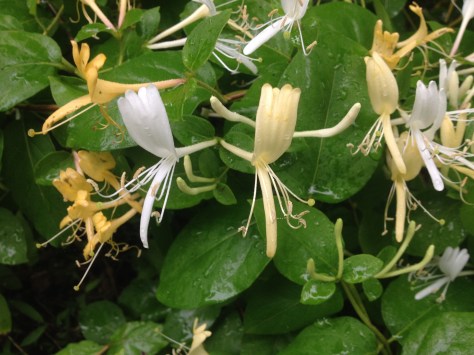
Seems no matter where I go these just-before-summer days I smell the sweet fragrance of warm days spent playing in my backyard. One of our favorite spots was a rose thicket with an opening just large enough for my sister and me to get through and just small enough for my parents NOT to be able to get through. Our thorny fortress was a quiet place of shared secrets, thoughtful conversations, and resting on our backs, hands clasped over stomachs, gazing through the leaves, planning the future. Giggling as our parents looked for us, yelling our names, walking past our private get-away, not stooping down to peer into the prickly wilds of our secret place. For a couple of weeks our castle was engulfed in fragrance. Two scents dominated these early summer days… rose and honeysuckle. When our timing was just right we would carefully pick honeysuckle flowers by the handful, tuck them into the folds of our t-shirts and crawl into our white-flower covered fort. Once inside, we would carefully remove the inner workings of each honeysuckle flower for the one tiny drop of sweetness it provided. Repeating this again and again until our stock of flowers was a tattered pile on our rose-fort floor and our mouths coated in the nectar of this wild vine.
Common Mullein (Verbascum thapsus) in the wilds of a fallow agricultural field.
Whenever I am headed out on an extended hike to experience primitive conditions (read no electric, no running water, lucky if there is an outhouse… but usually we aren’t so lucky) I look longingly at these plants before heading out into the wild, knowing that once I am in the woods, I won’t be seeing them again. Those soft velvety leaves sure look like they’ll come in handy once the inevitable occurs on a multi-day hike.
When I was young nearly EVERY vacation we went on had to involve a Scenic Railroad in order to happen. In other words, no train- we weren’t going there. I think the only reason we went to Disney (AKA “Ratland” by my train-loving dad) was because of the Big Thunder Mountain Railroad. (This incident left me in tears and fearful of roller coasters until my senior year in high school when we HAD to ride roller coasters in order to complete physics experiments at Great Adventure’s Physics Day. My so-called friends convinced me to not only get on a roller coaster, but to get on the one that had a loop and went backwards. Now I’ll ride nearly any roller-coaster. I guess they were good friends after all.) As my dad feels about trains, I feel about waterfalls. Wherever my adventures take me I seek out the waterfalls nearby. Over the past couple of weekends I was lucky enough to be near quite a few falls, and the timing was perfect to see a great variety of wildflowers as well.
“Without natural resources life itself is impossible. From birth to death, natural resources, transformed for human use, feed, clothe, shelter, and transport us. Upon them we depend for every material necessity, comfort, convenience, and protection in our lives. Without abundant resources prosperity is out of reach.” ~ Gifford Pinchot
Today I take you to Grey Towers. Have you been? For those of you who aren’t familiar, Grey Towers was the home of Gifford Pinchot. Who was Gifford Pinchot? Twice the governor of Pennsylvania and before that the first chief of the US Forestry Service. It is said that Gifford Pinchot is the ‘father’ of the conservation movement. Located in Milford, PA, “The Birthplace of the Conservation Movement”, Grey Towers stands upon a hill looking east towards France, a nod to the family’s French Huguenot heritage. Originally a summer home of his parents, this sprawling estate became the permanent home of the Gifford and wife Cornelia in order to establish Pennsylvania residency so Gifford could eventually run for governor. Conservation, horticulture, historic architecture, politics, a dining room table where you float your food to the guests…who could ask for more from a road trip stop?
“For Greater Knowledge of the Land and Its Uses.”
Built so the home would look east to France. That’s NJ in the distance.
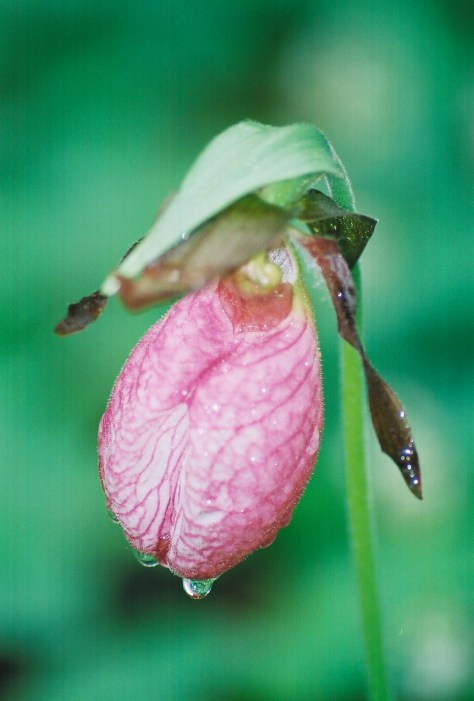
‘Tis the season. I am getting beautiful pictures sent to my email and phone. The orchids are blooming! Friends share their finds with me regularly and each one excites me. These are not the run-of-the-mill tropical orchids you can now find in row after row at the big box stores. Though they are lovely in their own test-tube-propagated way. These are the wild, native, I-can’t-believe-I-just-found-an-orchid, orchids that make even the most grueling, mosquito ridden, tick infested, poison ivy covered hike worth the effort. May through October, I hike with one eye on the trail and one eye in the woods looking for bright spots of color that would indicate an orchid.
Showy Orchis, just one of the orchid pics I received so far this year from friends on their own adventures. Photo by Erin Range
White tropical Phalaenopsis Orchid, or Moth Orchid. Commonly found in the wilds of big box stores and garden centers. Much more easily found and propagated than our native orchids.







 HORT travels