“American Bull” by Lorraine Vail at the Morris Arboretum, Philadelphia PAWhile I tend to find the fall colors of the native trees and shrubs here in the Northeast and Mid-Atlantic region something I cannot live without and something that makes me endlessly happy and at peace, others see the changing colors as the sure sign that winter is coming. They can’t enjoy the autumn display because all of those falling leaves depressingly morph into falling snowflakes as they watch them twirl down from the canopy.
As fall proceeds into its second month some lament the end of the growing season, putting away gloves and cleaning tools. Seed catalogs and garden magazines are piled up next to the couch for winter reading. People start to prepare for winter hibernation.
When it is time to sculpt pumpkins, people tend to think less about gardens and gardening as the changing of seasons leads us to think less about watering and weeds and more about turkey stuffing and present wrapping.
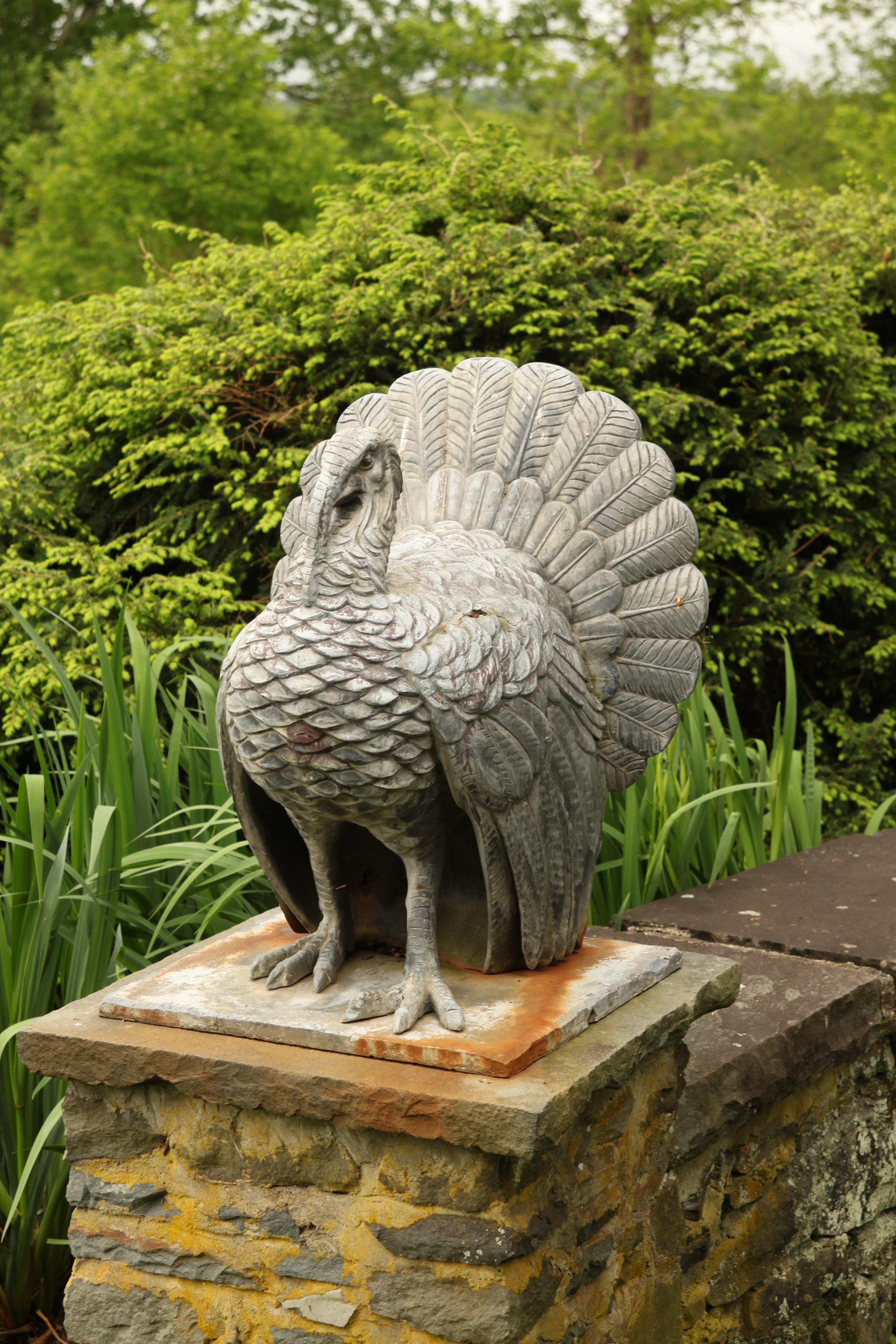
Turkey at Grey Towers Milford, PABut for those of us who enjoy the seasons, who want to explore wherever and whenever, I encourage fall and winter visits to gardens. Perhaps you have a friend or loved one who isn’t so much into gardening but likes to get outside. Drag them to a public garden or museum with outdoor sculptures. You as a gardener, or plant admirer, or nature admirer will find sculptures that will fill the gardening void in the fall and winter months. Some of my favorites from my horticulture travels are here.
Monkey Puzzle Tree (Araucaria araucana) is NOT a Pine Tree
According to my dad all cats are girls and all dogs are boys. That’s just the way it is. Every cat is a ‘she’ and every dog is a ‘he’. Of course for many years we had a male cat and a female dog, but that didn’t matter. My dad doesn’t seem to be alone in this sentiment. My father-in-law ex-father-in-law also always refers to dogs in the masculine and cats in the feminine.
Something similar happens at this time of the year. As people start searching for their Christmas trees, often they refer to every Christmas-tree shaped object in the lot and in the woods as a pine tree. Just like all cats are not girls and all dogs are not boys, all evergreens are not pine trees.
I’ve heard and read that when you thru-hike the Appalachian Trail, trail magic happens. This is the “kindness of strangers” that happens on the trail. Someone gives a hiker a lift to a dry shelter on a rainy day or leaves some delicious snack in a shelter for a weary hiker to find, that’s magic. I have only heard and read about this and that is likely all I’ll ever do. Though the idea of thru-hiking the Appalachian Trail is appealing to me, I would never be able to do it. Well, I could do it, but it would take me 432,567 days because I would be stopping to look at every flower and bud, taking pictures of each leaf and nifty pattern and talking to anyone who will listen about the wonder of the plants around. (Think I’m exaggerating? Just talk with ANYONE who’s ever hiked with me!)
Ouch! That was definitely an acorn that just hit me on the head. There seems to be a bumper crop of them falling from our trees this year. When a slight breeze blows it sounds like hail falling through the trees. THUNK! A black walnut hits the top of the car as I cruise along River Road taking in the fall colors and noting Delaware River water levels (low). Holy moly was that loud and a little bit scary! No dents (in my head or in the car) but all of this fruit flinging has gotten me thinking about the purpose of fall.
Turns out that there are other reasons for fruits to fall from the trees than providing ammunition for you to throw at your younger (though similar sized – I’ll have you know) sibling. The autumn colors signal to many of us winter is on the way. It’s time to split the rest of the firewood, dig out the long sleeves and extra blankets and find the snow shovel underneath the accumulation of beach chairs and coolers that piled up this summer. Similarly, for wildlife, the changing of the leaves signals a bounty to be eaten and preserved for the cold winter months.
Think about the small red fruits of a dogwood or spicebush, they would be tough to see from a bird’s location high above, and it would take a lot of energy to stop at each tree to figure out if there were ripe fruits to eat. Instead, birds can keep an eye out for the changing of the colors, an entire tree full of red leaves signals to those flying above ripe fruits to be had, fuel for continuing the long migration or fattening up to make it through a (hopefully) snowy winter.
As I explore various places this fall I take a look at the fruits, and the trees from which they fell, and consider their purpose and value.
Seward Johnson’s Sculpture “Down to Earth” Grounds for Sculpture – Hamilton, NJ
Grounds for Sculpture and Sayen House and Gardens
One of my most favorite trees (and contrary to popular belief they are not ALL my favorites) is the Katsura Tree (Cercidiphyllum japonicum). Typically I focus on native plants and their role in our ecosystem and place in plant communities. I like to explore faunal associations and examine their potential for ornamental use. This tree, native to Japan, captures all of my attention because of its fragrance. Katsuras don’t emit their perfume when flowering like most trees do. Katsura give off the most wonderfully sweet fragrance just before their leaves start to change into their apricot splendor of autumn. The scent is distinctive enough that you will smell it before you even see a Katsura and just know one is around, somewhere.
Fall is my favorite season. We are so lucky here in the Northeast and Mid-Atlantic that we get to experience the changing of the seasons through riotous colors thrown together painting hillsides, roadways and mountaintops. As I look out my window Red Oak (Quercus rubra) leaves are just starting to show the crimson they are known for and the cat-faced shaped leaves of Tulip Trees (Liriodendron tulipifera) are turning golden. The only thing that makes this show better is the addition of fragrance and that’s where Katsura comes in.
I, accidentally, timed my visit to Grounds for Sculpture just perfectly for a stunning sensory experience. The place is loaded with Katsura trees and they were all alerting their presence on the breeze. Sculptures you can get up close to and touch, ornamental gardens and Katsura perfume in the air. I was in heaven. A little early for fall color, but if there was fall color, there wouldn’t have been any perfume on the wind. Some compare the scent to cotton candy, others liken it to brown sugar or a cake baking. In fact, according to Michael Dosmann, curator of living collections at the Arnold Arboretum in Boston, “Germans call this tree ‘kuchenbaum,’ which translates to ‘cake tree’.”
The heart-shaped leaves of Katsura
Typical form of Katsura.
Peeking through the Wisteria tunnel finding a mom reading to her child under a Katsura. Sculpture by Seward Johnson.
Bloom of Seaside Goldenrod (Solidago sempervirens)
“Oh sweetie, not you, what are you doing here?”
said the security guard behind the desk in the campus security office. It is the night before graduation and I am being escorted with my then boyfriend, now husband ex-husband, by local police into the security office for on-campus drinking.
The fact that we are both of-age and the campus wasn’t a dry campus when we both started school (I mean shouldn’t there be a grandfather clause?) and that we didn’t even have anything to drink (honestly!) – we were leaving campus – cooler in tow – for an off-campus party – doesn’t mean anything to these uniformed fellas. I am trying to keep calm and tell the officer that in fact I WILL be graduating tomorrow regardless of what he thinks. He’s telling me I am not going to walk. This is the first time I have been in trouble at college (unless you count the whole outdoor holiday lights inside the dorm debacle) in the 4 years I have been there, and it is the next to last day of school.
The reason the security guard was so surprised to see me was because the only time I’ve been in that small structure was to buy my parking pass. My relationship was fairly new at the time, but I was fairly sure this was not his first run-in with security. A few hours and a confiscated cooler later, (they decided we weren’t doing anything wrong after-all) we’re allowed to go and I graduated the next day. If it hadn’t been for the company I was keeping, would I have been in that situation? Probably not, I probably would’ve been reading a book somewhere quiet. But I also wouldn’t have had nearly as much fun, met as many terrific people or had stories to tell.
August 26th was Women’s Equality Day. The articles and news stories highlighting this day and the reason for it got me thinking back to a road trip we took a few years ago. We decided we would head out to Michigan.
When Tree Boy* and I decided we would spend our summer vacation on a Road Trip to Michigan, most people couldn’t understand why we would go to Michigan. We were asked multiple times if we had relatives there, as if that must be a prerequisite for trekking way out there.
To be honest, we had a lofty goal – to kayak in each of the Great Lakes. The way we travel makes some anxious. No plans, no reservations, no place to be at a certain time. We just go and see where we end up. We may investigate a place or two that looks interesting to us, write it down so we don’t forget and if we happen to end up there, well, great! If not, well, that’s okay too. For us part of the adventure is not knowing what we’ll see or where we’ll end up. Has this meant sleeping alongside the highway, no access to state parks on busy weekends, sure! Has this meant we stumble upon things we may not have seen during a well-planned, each- minute-perfectly-scheduled-vacation – absolutely!
As we point our van towards Lake Michigan, imagine my surprise as I examine the map – yep, a paper map – difficult to get the big picture on a small screen – and notice a little green mark with the label LH Bailey Museum. There’s only one LH Bailey I know of. The “Father of American Horticulture” Liberty Hyde Bailey. How could a Horticulturist and a Landscape Designer NOT investigate?
Moving to a new state, even just across one big river, can lead to interesting new discoveries. Two horticultural discoveries have intrigued me since I have moved here. These are two late summer blooming flowers I was unfamiliar with until I started exploring the natural areas around the place I now call home.
The fruit cluster, or Bob, of Smooth Sumac (Rhus glabra) along a Rail Trail in Southeastern PA
My dad looks at me dubiously over the dining room table all decked out for Thanksgiving. I recognize the look, because I have inherited it. If I feel someone is feeding me a line of crap you can read it all over my face, and that is what I am seeing here, across the table. Why the look? I have just told my dad the contents of the flower arrangement nestled among the good china, newly shined silver and gold rimmed wine glasses. I have always loved to go outside and gather what’s interesting from the yard to create seasonally representative flower arrangements. I enjoy doing this anytime but always create something for the big holidays. To me, it is fun to explore the yard in a different way, looking at plants and their parts as components of a floral design instead of a landscape design or plant community.
My dad has every right to be a little doubtful about this creation. My penchant for bringing nature onto the holiday table has certainly resulted in our fair share of spiders, caterpillars, moths and other insects venturing out from their botanical hiding place and onto the crystal butter dish. This is not lost on him. Family and friends at these dinners have always taken these visitors with good humor, laughing as, red-faced, I capture the critter and release it back into the wild. This late afternoon, the guests have not yet arrived, the table is still being set and I just placed an offending flower arrangement in the center of the table.
Of course a garden is more than flowers. There’s weeds and bugs too! The nice thing about gardening in this region – the mid-atlantic – is that we can create a garden that has flowers blooming nearly 12 months of the year. Sure those late fall and winter flowers may not be the showstopper the Hibiscus pictured above is, but they are flowers nonetheless. Summer is the time when flowers abound, annuals like impatiens, begonias and marigolds brighten up gardens throughout the warmer months, only succumbing when the first frost hits, turning them into mushy piles of petals. For those of us more inclined towards the perennial persuasion of plants, having blooms throughout the growing season means developing a diversity in the garden that ensures multiple seasons of blooms. It is not as simple as planting rows of impatiens we know will keep blooming through the summer. We have to plan a sequence of flowering to ensure something’s in bloom whenever we gaze into the garden. I love this challenge. When I worked in an urban educational garden, I challenged myself to create a garden with 4 seasons of blooms. Not just four seasons of interest, which we had, but I wanted visitors to see flowers in the city whenever they visited. Through careful selection and combination of trees, shrubs, perennials and bulbs flowers could be found 12 months of the year, much to my delight and to the delight of the visitors.
But there’s so much more to a garden than flowers. I always tell my students while flowers may be present for just a short time, foliage is there a lot longer and you should always consider the foliage when you are planning to add a plant to the garden. When considering interest in the garden and bloom times, don’t forget about the foliage!
This was cemented in my brain after a trip to Costa Rica. I had never been there before and it was pre-google (& pre-digital camera – 23 rolls of film later!). I was expecting orchids dripping off the trees, practically slapping me in the face everywhere I went. I expected carpets of tropical flowers lining every road and trail. What I didn’t expect was green. Lots of green, everywhere green and not many flowers to speak of (well, at least compared to what my vivid imagination conjured). During a canopy tour, I peered over the swinging bridge railing into the top of the rain forest and noticed how different all the green was. There were countless shades of green and the textures ranged from the coarse Monstera speciosa or Swiss Cheese Plant to the lacy Tree Fern. It was fantastically beautiful. From then on I had an appreciation for how beautiful and interesting foliage can be.
Costa Rica from above
My recent visit to the Scott Arboretum of Swarthmore College really solidified for me what one can do in a garden by simply taking a considered look at foliage.
Just a small portion of the Terry Shane Teaching Garden at Scott Arboretum







 HORT travels