South Haven, Michigan


Lichens on a Michigan Forest  Floor
Lichens (Cladonia spp)on a Michigan Forest Floor

August 26th was Women’s Equality Day.  The articles and news stories highlighting this day and the reason for it got me thinking back to a road trip we took a few years ago. We decided we would head out to Michigan.

When Tree Boy* and I decided we would spend our summer vacation on a Road Trip to Michigan, most people couldn’t understand why we would go to Michigan. We were asked multiple times if we had relatives there, as if that must be a prerequisite for trekking way out there.

To be honest, we had a lofty goal – to kayak in each of the Great Lakes. The way we travel makes some anxious. No plans, no reservations, no place to be at a certain time. We just go and see where we end up. We may investigate a place or two that looks interesting to us, write it down so we don’t forget and if we happen to end up there, well, great! If not, well, that’s okay too.  For us part of the adventure is not knowing what we’ll see or where we’ll end up.  Has this meant sleeping alongside the highway, no access to state parks on busy weekends, sure! Has this meant we stumble upon things we may not have seen during a well-planned, each- minute-perfectly-scheduled-vacation – absolutely!

As we point our van towards Lake Michigan, imagine my surprise as I examine the map – yep, a paper map – difficult to get the big picture on a small screen – and notice a little green mark with the label LH Bailey Museum. There’s only one LH Bailey I know of. The “Father of American Horticulture” Liberty Hyde Bailey. How could a Horticulturist and a Landscape Designer NOT investigate?
Continue reading South Haven, Michigan

Yellow Late-Summer Blooms

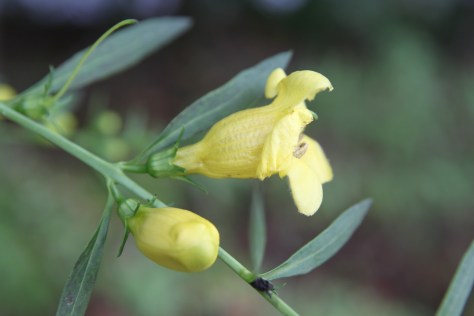
Yellow False Foxglove Flowers

Moving to a new state, even just across one big river, can lead to interesting new discoveries.  Two horticultural discoveries have intrigued me since I have moved here. These are two late summer blooming flowers I was unfamiliar with until I started exploring the natural areas around the place I now call home.

Continue reading Yellow Late-Summer Blooms

Sumac


Smooth Sumac Fruit (c) Kathleen V Salisbury
The fruit cluster, or Bob, of Smooth Sumac (Rhus glabra) along a Rail Trail in Southeastern PA


My dad looks at me dubiously over the dining room table all decked out for Thanksgiving. I recognize the look, because I have inherited it. If I feel someone is feeding me a line of crap you can read it all over my face, and that is what I am seeing here, across the table. Why the look? I have just told my dad the contents of the flower arrangement nestled among the good china, newly shined silver and gold rimmed wine glasses. I have always loved to go outside and gather what’s interesting from the yard to create seasonally representative flower arrangements. I enjoy doing this anytime but always create something for the big holidays. To me, it is fun to explore the yard in a different way, looking at plants and their parts as components of a floral design instead of a landscape design or plant community.

My dad has every right to be a little doubtful about this creation. My penchant for bringing nature onto the holiday table has certainly resulted in our fair share of spiders, caterpillars, moths and other insects venturing out from their botanical hiding place and onto the crystal butter dish.  This is not lost on him. Family and friends at these dinners have always taken these visitors with good humor, laughing as, red-faced, I capture the critter and release it back into the wild. This late afternoon, the guests have not yet arrived, the table is still being set and I just placed an offending flower arrangement in the center of the table.

Continue reading Sumac

Textures

Marsh Mallow (Hibiscus moscheutos)

Of course a garden is more than flowers. There’s weeds and bugs too! The nice thing about gardening in this region – the mid-atlantic – is that we can create a garden that has flowers blooming nearly 12 months of the year. Sure those late fall and winter flowers may not be the showstopper the Hibiscus pictured above is, but they are flowers nonetheless. Summer is the time when flowers abound, annuals like impatiens, begonias and marigolds brighten up gardens throughout the warmer months, only succumbing when the first frost hits, turning them into mushy piles of petals. For those of us more inclined towards the perennial persuasion of plants, having blooms throughout the growing season means developing a diversity in the garden that ensures multiple seasons of blooms. It is not as simple as planting rows of impatiens we know will keep blooming through the summer. We have to plan a sequence of flowering to ensure something’s in bloom whenever we gaze into the garden. I love this challenge. When I worked in an urban educational garden, I challenged myself to create a garden with 4 seasons of blooms. Not just four seasons of interest, which we had, but I wanted visitors to see flowers in the city whenever they visited. Through careful selection and combination of trees, shrubs, perennials and bulbs flowers could be found 12 months of the year, much to my delight and to the delight of the visitors.

But there’s so much more to a garden than flowers. I always tell my students while flowers may be present for just a short time, foliage is there a lot longer and you should always consider the foliage when you are planning to add a plant to the garden. When considering interest in the garden and bloom times, don’t forget about the foliage!

This was cemented in my brain after a trip to Costa Rica. I had never been there before and it was pre-google (& pre-digital camera – 23 rolls of film later!). I was expecting orchids dripping off the trees, practically slapping me in the face everywhere I went. I expected carpets of tropical flowers lining every road and trail. What I didn’t expect was green. Lots of green, everywhere green and not many flowers to speak of (well, at least compared to what my vivid imagination conjured). During a canopy tour, I peered over the swinging bridge railing into the top of the rain forest and noticed how different all the green was. There were countless shades of green and the textures ranged from the coarse Monstera speciosa or Swiss Cheese Plant to the lacy Tree Fern. It was fantastically beautiful. From then on I had an appreciation for how beautiful and interesting foliage can be.

Costa Rica from above

My recent visit to the Scott Arboretum of Swarthmore College really solidified for me what one can do in a garden by simply taking a considered look at foliage.

Scott Arboretum
Just a small portion of the Terry Shane Teaching Garden at Scott Arboretum

Continue reading Textures

Blueberries

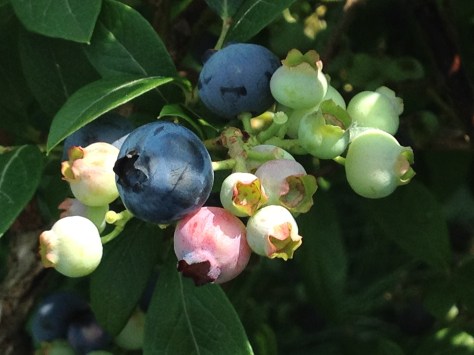
Many Stages of Blueberry Fruit

“Girls, can you run outside and pick some blueberries for the pancakes?”

was a question common in our house each June and July Sunday. We would grab a cup and head out to the woods, not the garden, the woods, to pick as many blueberries as the cups would hold, presenting them proudly to mom and dad who were in the kitchen whipping up pancake batter while we stalked the wild berries. If I remember correctly, it was “2 for the cup one for me”, or maybe the other way around. I think about this during a recent visit to western Maine as I squat down to examine small blueberry bushes, with diminutive fruit on them. These are similar to those we harvested beneath the oaks and pines in NJ but are a far cry from the behemoth berries I picked a week ago from a friends farm in Northern NJ.

Continue reading Blueberries

About that tree in Brooklyn (or… Adventures in Finding Free Things to Do in the City…)

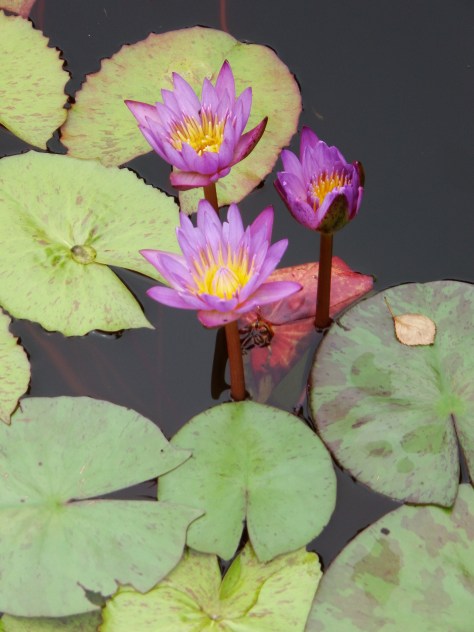
Lily Pond at the Narrows Botanical Garden

Perhaps you read the Betty Smith novel A Tree Grows in Brooklyn.  {{Spoiler alert}} The tree in the story was an Ailanthus altissima or Tree of Heaven. This tree is known for its ability to thrive in even the harshest of conditions, hence its use as a metaphor for the strength and tenacity of the main character in the book.

“There’s a tree that grows in Brooklyn. Some people call it the Tree of Heaven. No matter where its seed falls, it makes a tree which struggles to reach the sky. It grows in boarded-up lots and out of neglected rubbish heaps.  It grows up out of cellar gratings. It is the only tree  that grows out of cement. It grows lushly…survives without sun, water, and seemingly without earth. It should be considered beautiful except that there are too many of it.” Betty Smith, A Tree Grows in Brooklyn

The “ghetto palm” (as my inner-city high school interns once described it to me) has become a bit too successful dominating roadsides and vacant lots in all but 6 of the states. Introduced from China as an ornamental plant Ailanthus was planted widely throughout the Northeast in the first half of the century. It fell out of favor with the horticultural crowd but despite its lack of popularity continued to insert itself into devoid and neglected areas of our landscape.  In his book Wild Urban Plants of the Northeast Peter Del Tredici asks us to take a different look at these weed plants colonizing waste spaces.  He suggests that these “weedy” and “spontaneous” plants benefit the cities by creating forests and the ecological benefits associated with forests, at no cost to the residents. Hmmm. Del Tredici says these are as important part of the urban landscape as the native plants restricted to protected natural areas and the highly maintained cultivated gardens on display throughout the city.

I am still digesting this point of view as it flies in the face of everything familiar to me. While I appreciate the sentiment, science and statistics, it is still hard for me to promote the embrace of invasive, weedy plant species to the detriment of native plants and the wildlife they support.  As I continue to consider and explore this topic, I visit those highly manicured cultivated garden spaces that are also an important part of the fabric of a city. This trip takes me to Brooklyn.

Continue reading About that tree in Brooklyn (or… Adventures in Finding Free Things to Do in the City…)

Viper’s Bugloss at 60MPH


Viper's Bugloss
Viper’s Bugloss (Echium vulgare)

Wait…what was that?!

Frequently my lead foot (it’s genetic I swear!) and my want to enjoy every plant around me are at odds.  At my speeds, you have to have a pretty impressive display to catch my eye! Such was the case with this stunner.  I zoomed past it, noticing a flash of blue as I hurried down the back road I had opted for over highway travel.  I know, what’s the point of taking back roads if I am just going to fly past all the scenery at warp speed? I don’t have an answer for you.

I continued on a little ways but that blue flash was really nagging me. I slowed down, because at Mach 10, you can’t stop on a dime in case you see another batch of beauty, planning to stop at the next patch I saw. But I only saw one plant here and one there, nothing like the spot of blue that managed to pierce the blur of trees and shrubs that was my adventure home. As is often the case with us speeders, U-Turn it is! I swung around, backtracking, more slowly this time, to get a closer look at this mystery flower.

Continue reading Viper’s Bugloss at 60MPH

The Small Things


Ahh the Ladybug...Everyone's Favorite carnivorous Beetle
Ahh the Ladybug…Everyone’s Favorite Carnivorous Beetle

Over the past couple of weeks I have been noticing the insect life on the plants near me. So many times I interact with people interested in gardening for the beauty of the flowers and the value of vegetables for their dinner table. Little do they think about the value of the fruits of our garden to the smallest residents, the insects. Rarely, when they consider their newest plant for their garden do they consider the beauty of the bloom or the fragrance of the flower is meant to attract insects, and just happens to be appealing to us as well.

People get frustrated when caterpillars chew holes in leaves, when bees surround the flowers planted near walkways. But that is the purpose of the flowers. They are just doing their job! The same can be said for the insects. I run into students when I am teaching expressing grave concern regarding the bugs in their yard, asking what they can do to get rid of them. “Pave your yard“, is my internal answer. Not much thrives on asphalt. Being an educator, my actual answer is an explanation of the insect/plant connection and ultimately the insect/human connection. You know, how without insects, our lives would be much much harder. Really, you can’t have beautiful flowers without the bugs that go along with them.

Continue reading The Small Things

Oakleaf Hydrangea

Oakleaf Hydrangea Flowers
Oakleaf Hydrangea (Hydrangea quercifolia) Flowers

One of my favorite plants is flowering in my yard right now. I love this plant. It is bold, in your face and it passes the multiple seasons of interest test.  Every time I see this bloom I am taken back to a forest in Mississippi. My sister and I were on our way back from a road trip to Louisiana, camping the whole time. We stopped in a state park along the Natchez Trace Parkway to take in the sights and stretch our legs following a short hiking trail that seemed made for just such a purpose. We stuck our heads through holes in large trees taking ‘selfies’ before it was the thing to do, watched new-to-us very large spiders make their way along handrails we dared not touch. Suddenly I stop and utter a “do you see that?!” from under the hand clasped over my mouth. I am that person. I get so excited when I see plants I have only known in landscapes thriving in the wild, where they have not been planted where they just ARE because they belong there. Sort of like the experience I had in Greece with the Bear’s Breeches.

Continue reading Oakleaf Hydrangea

The Sweet Smell of Strangulation

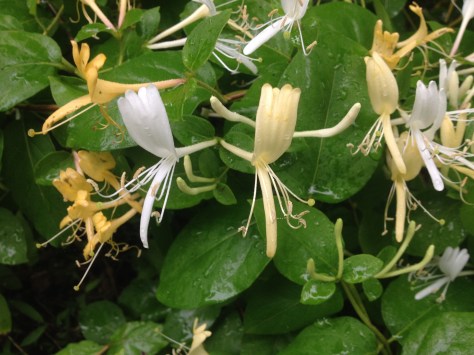
Japanese Honeysuckle Flowers

Seems no matter where I go these just-before-summer days I smell the sweet fragrance of warm days spent playing in my backyard. One of our favorite spots was a rose thicket with an opening just large enough for my sister and me to get through and just small enough for my parents NOT to be able to get through. Our thorny fortress was a quiet place of shared secrets, thoughtful conversations, and resting on our backs, hands clasped over stomachs, gazing through the leaves, planning the future. Giggling as our parents looked for us, yelling our names, walking past our private get-away, not stooping down to peer into the prickly wilds of our secret place. For a couple of weeks our castle was engulfed in fragrance. Two scents dominated these early summer days… rose and honeysuckle. When our timing was just right we would carefully pick honeysuckle flowers by the handful, tuck them into the folds of our t-shirts and crawl into our white-flower covered fort. Once inside, we would carefully remove the inner workings of each honeysuckle flower for the one tiny drop of sweetness it provided. Repeating this again and again until our stock of flowers was a tattered pile on our rose-fort floor and our mouths coated in the nectar of this wild vine.

Continue reading The Sweet Smell of Strangulation