“American Bull” by Lorraine Vail at the Morris Arboretum, Philadelphia PAWhile I tend to find the fall colors of the native trees and shrubs here in the Northeast and Mid-Atlantic region something I cannot live without and something that makes me endlessly happy and at peace, others see the changing colors as the sure sign that winter is coming. They can’t enjoy the autumn display because all of those falling leaves depressingly morph into falling snowflakes as they watch them twirl down from the canopy.
As fall proceeds into its second month some lament the end of the growing season, putting away gloves and cleaning tools. Seed catalogs and garden magazines are piled up next to the couch for winter reading. People start to prepare for winter hibernation.
When it is time to sculpt pumpkins, people tend to think less about gardens and gardening as the changing of seasons leads us to think less about watering and weeds and more about turkey stuffing and present wrapping.
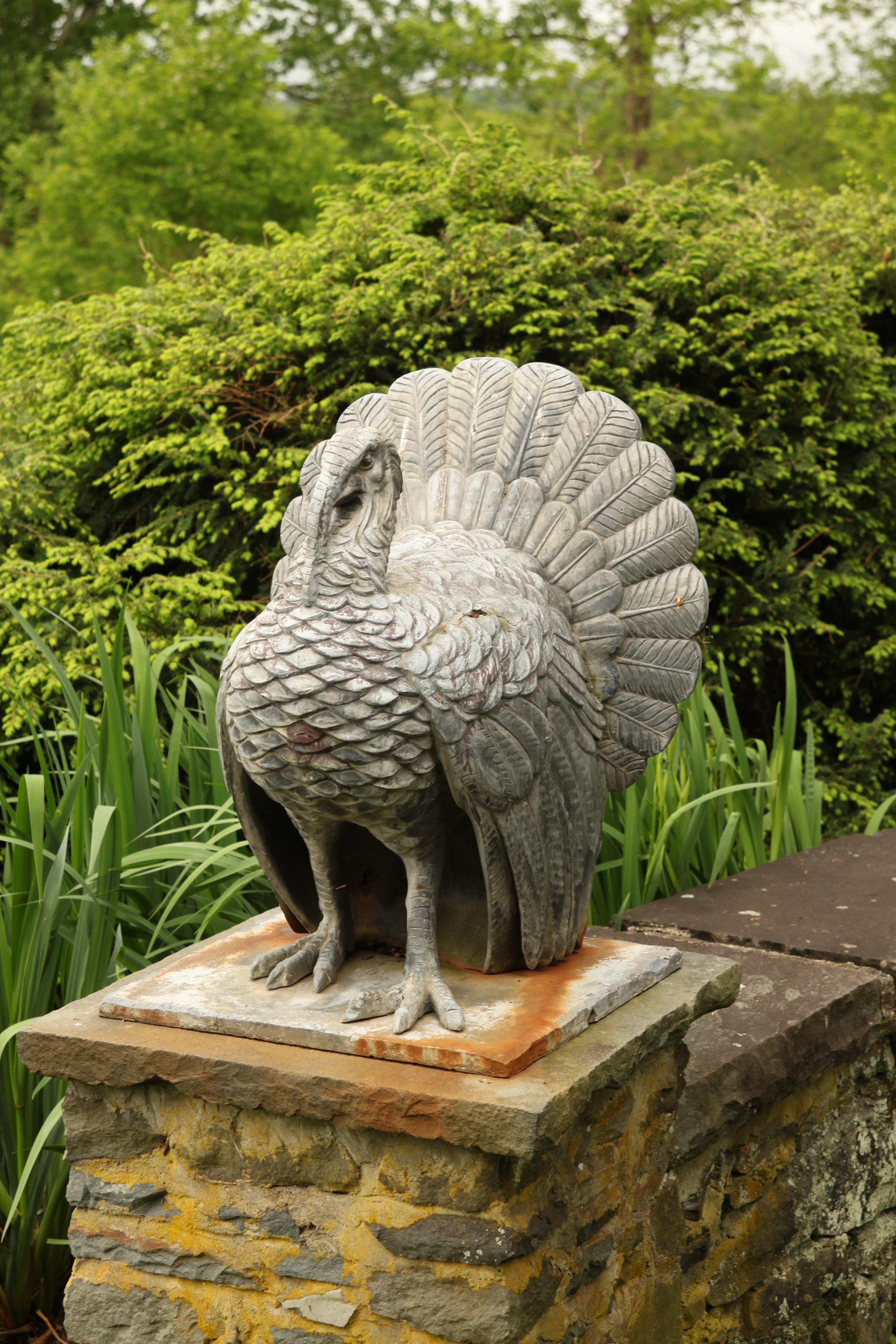
Turkey at Grey Towers Milford, PABut for those of us who enjoy the seasons, who want to explore wherever and whenever, I encourage fall and winter visits to gardens. Perhaps you have a friend or loved one who isn’t so much into gardening but likes to get outside. Drag them to a public garden or museum with outdoor sculptures. You as a gardener, or plant admirer, or nature admirer will find sculptures that will fill the gardening void in the fall and winter months. Some of my favorites from my horticulture travels are here.
All things vintage strike my fancy and this garden had me at its sign:
The Retro Sign of Sunken Gardens – St. Petersburg, Florida
I am thinking of this small gem today as I keep the wood stove burning and the thermometer doesn’t get out of the single digits. Sunken Gardens has been around since 1935 when George Turner Sr. opened his 6 acre property to the public to show off his walled gardens for $0.25 a person. Starting out as a place with a sink hole and a shallow lake, Mr. Turner turned this land into a rich area to grow fruits and vegetable by installing a tile drainage system. He was a plumber by vocation and horticulturist by avocation, Turner’s gardening transitioned from the fruits and vegetables he sold at his road-side stand to exotic flowers and tropical plants. Turner maintained the gardens, eventually leaving them open year round and amassing a flock of flamingos numbering in the hundreds. Turner’s sons purchased the property from their father and the garden became world famous. Celebrities visited and beauty contests were held there. The gardens went through many changes, a large gift shop (at one time the largest in the world), walk-through aviary, religious exhibits. Due to the construction of a nearby interstate and the creation of large theme parks, this garden, like many others, experienced a decline in audience and an increase in operational expenses that led a discussion concerning closing the gardens. The City of St. Petersburg now owns the attraction. Since 1999 the Parks Department has been operating and maintaing this oasis with great help from an army of volunteers. Right behind this sign is a strip mall and bustling 4th Street. You must enter, and leave (of course) through the gift shop. Modest, I’m sure, compared to the mega-shop of its past, this shop featured locally made and horticulture themed gifts for all ages and budgets. When you park in the lot, you have no idea what’s in store for you. The garden is walled, and even at my height, I couldn’t sneak a peak to see what was inside.
A Tropical View in the Sunken Gardens, St. Petersburg, FL
Seward Johnson’s Sculpture “Down to Earth” Grounds for Sculpture – Hamilton, NJ
Grounds for Sculpture and Sayen House and Gardens
One of my most favorite trees (and contrary to popular belief they are not ALL my favorites) is the Katsura Tree (Cercidiphyllum japonicum). Typically I focus on native plants and their role in our ecosystem and place in plant communities. I like to explore faunal associations and examine their potential for ornamental use. This tree, native to Japan, captures all of my attention because of its fragrance. Katsuras don’t emit their perfume when flowering like most trees do. Katsura give off the most wonderfully sweet fragrance just before their leaves start to change into their apricot splendor of autumn. The scent is distinctive enough that you will smell it before you even see a Katsura and just know one is around, somewhere.
Fall is my favorite season. We are so lucky here in the Northeast and Mid-Atlantic that we get to experience the changing of the seasons through riotous colors thrown together painting hillsides, roadways and mountaintops. As I look out my window Red Oak (Quercus rubra) leaves are just starting to show the crimson they are known for and the cat-faced shaped leaves of Tulip Trees (Liriodendron tulipifera) are turning golden. The only thing that makes this show better is the addition of fragrance and that’s where Katsura comes in.
I, accidentally, timed my visit to Grounds for Sculpture just perfectly for a stunning sensory experience. The place is loaded with Katsura trees and they were all alerting their presence on the breeze. Sculptures you can get up close to and touch, ornamental gardens and Katsura perfume in the air. I was in heaven. A little early for fall color, but if there was fall color, there wouldn’t have been any perfume on the wind. Some compare the scent to cotton candy, others liken it to brown sugar or a cake baking. In fact, according to Michael Dosmann, curator of living collections at the Arnold Arboretum in Boston, “Germans call this tree ‘kuchenbaum,’ which translates to ‘cake tree’.”
The heart-shaped leaves of Katsura
Typical form of Katsura.
Peeking through the Wisteria tunnel finding a mom reading to her child under a Katsura. Sculpture by Seward Johnson.
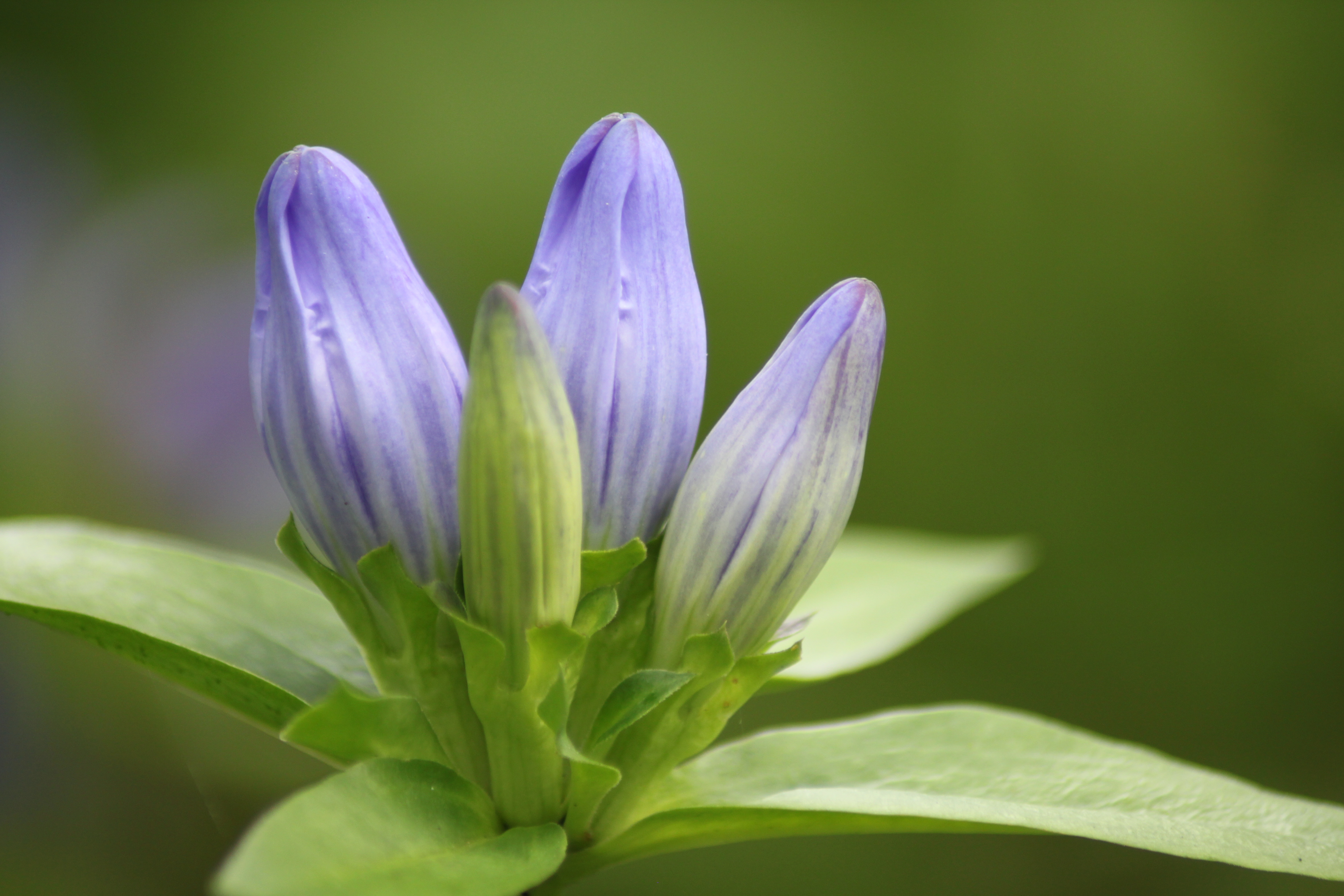
Flower colors can range from pale purple to deep sapphire depending on age, light, time of day.
It’s hard enough for me to get my kayak down a whitewater river upright without being distracted by flowers along the way. I am happy to say on my latest voyage, it was not the blooms that tripped me up but my own inexperience. (I’m still learning the basics when it comes to whitewater kayaking and as the two River Zen Masters in my life constantly remind me “Kayaking is what you do between swims”… it is my own mantra now.)
Paddling with other horticulturally-minded people means extra time on the water, paddling back upstream to get a closer look at the flowers along the bank. This trip was no exception. Today’s distraction – Closed Gentians. I don’t know if it is the seeming simplicity of these flowers, the intense color or their apparent rarity that makes me stop (or paddle back upstream) to look at them, closely, and for a while, every time I see them. This day these were blooming along with White Turtleheads (Chelone glabra), and Red Cardinal Flower (Lobelia cardinals).
Headed to shore for a water-side botanical exploration
Closed Gentians along the banks of the Lehigh River
These would have been inundated the week before during a large water release.. Here you seem them with Sensitive Ferns, Violets and thalictrum
August 26th was Women’s Equality Day. The articles and news stories highlighting this day and the reason for it got me thinking back to a road trip we took a few years ago. We decided we would head out to Michigan.
When Tree Boy* and I decided we would spend our summer vacation on a Road Trip to Michigan, most people couldn’t understand why we would go to Michigan. We were asked multiple times if we had relatives there, as if that must be a prerequisite for trekking way out there.
To be honest, we had a lofty goal – to kayak in each of the Great Lakes. The way we travel makes some anxious. No plans, no reservations, no place to be at a certain time. We just go and see where we end up. We may investigate a place or two that looks interesting to us, write it down so we don’t forget and if we happen to end up there, well, great! If not, well, that’s okay too. For us part of the adventure is not knowing what we’ll see or where we’ll end up. Has this meant sleeping alongside the highway, no access to state parks on busy weekends, sure! Has this meant we stumble upon things we may not have seen during a well-planned, each- minute-perfectly-scheduled-vacation – absolutely!
As we point our van towards Lake Michigan, imagine my surprise as I examine the map – yep, a paper map – difficult to get the big picture on a small screen – and notice a little green mark with the label LH Bailey Museum. There’s only one LH Bailey I know of. The “Father of American Horticulture” Liberty Hyde Bailey. How could a Horticulturist and a Landscape Designer NOT investigate?
Of course a garden is more than flowers. There’s weeds and bugs too! The nice thing about gardening in this region – the mid-atlantic – is that we can create a garden that has flowers blooming nearly 12 months of the year. Sure those late fall and winter flowers may not be the showstopper the Hibiscus pictured above is, but they are flowers nonetheless. Summer is the time when flowers abound, annuals like impatiens, begonias and marigolds brighten up gardens throughout the warmer months, only succumbing when the first frost hits, turning them into mushy piles of petals. For those of us more inclined towards the perennial persuasion of plants, having blooms throughout the growing season means developing a diversity in the garden that ensures multiple seasons of blooms. It is not as simple as planting rows of impatiens we know will keep blooming through the summer. We have to plan a sequence of flowering to ensure something’s in bloom whenever we gaze into the garden. I love this challenge. When I worked in an urban educational garden, I challenged myself to create a garden with 4 seasons of blooms. Not just four seasons of interest, which we had, but I wanted visitors to see flowers in the city whenever they visited. Through careful selection and combination of trees, shrubs, perennials and bulbs flowers could be found 12 months of the year, much to my delight and to the delight of the visitors.
But there’s so much more to a garden than flowers. I always tell my students while flowers may be present for just a short time, foliage is there a lot longer and you should always consider the foliage when you are planning to add a plant to the garden. When considering interest in the garden and bloom times, don’t forget about the foliage!
This was cemented in my brain after a trip to Costa Rica. I had never been there before and it was pre-google (& pre-digital camera – 23 rolls of film later!). I was expecting orchids dripping off the trees, practically slapping me in the face everywhere I went. I expected carpets of tropical flowers lining every road and trail. What I didn’t expect was green. Lots of green, everywhere green and not many flowers to speak of (well, at least compared to what my vivid imagination conjured). During a canopy tour, I peered over the swinging bridge railing into the top of the rain forest and noticed how different all the green was. There were countless shades of green and the textures ranged from the coarse Monstera speciosa or Swiss Cheese Plant to the lacy Tree Fern. It was fantastically beautiful. From then on I had an appreciation for how beautiful and interesting foliage can be.
Costa Rica from above
My recent visit to the Scott Arboretum of Swarthmore College really solidified for me what one can do in a garden by simply taking a considered look at foliage.
Just a small portion of the Terry Shane Teaching Garden at Scott Arboretum
Perhaps you read the Betty Smith novel A Tree Grows in Brooklyn. {{Spoiler alert}} The tree in the story was an Ailanthus altissima or Tree of Heaven. This tree is known for its ability to thrive in even the harshest of conditions, hence its use as a metaphor for the strength and tenacity of the main character in the book.
“There’s a tree that grows in Brooklyn. Some people call it the Tree of Heaven. No matter where its seed falls, it makes a tree which struggles to reach the sky. It grows in boarded-up lots and out of neglected rubbish heaps. It grows up out of cellar gratings. It is the only tree that grows out of cement. It grows lushly…survives without sun, water, and seemingly without earth. It should be considered beautiful except that there are too many of it.” Betty Smith, A Tree Grows in Brooklyn
The “ghetto palm” (as my inner-city high school interns once described it to me) has become a bit too successful dominating roadsides and vacant lots in all but 6 of the states. Introduced from China as an ornamental plant Ailanthus was planted widely throughout the Northeast in the first half of the century. It fell out of favor with the horticultural crowd but despite its lack of popularity continued to insert itself into devoid and neglected areas of our landscape. In his book Wild Urban Plants of the Northeast Peter Del Tredici asks us to take a different look at these weed plants colonizing waste spaces. He suggests that these “weedy” and “spontaneous” plants benefit the cities by creating forests and the ecological benefits associated with forests, at no cost to the residents. Hmmm. Del Tredici says these are as important part of the urban landscape as the native plants restricted to protected natural areas and the highly maintained cultivated gardens on display throughout the city.
I am still digesting this point of view as it flies in the face of everything familiar to me. While I appreciate the sentiment, science and statistics, it is still hard for me to promote the embrace of invasive, weedy plant species to the detriment of native plants and the wildlife they support. As I continue to consider and explore this topic, I visit those highly manicured cultivated garden spaces that are also an important part of the fabric of a city. This trip takes me to Brooklyn.
When I was young nearly EVERY vacation we went on had to involve a Scenic Railroad in order to happen. In other words, no train- we weren’t going there. I think the only reason we went to Disney (AKA “Ratland” by my train-loving dad) was because of the Big Thunder Mountain Railroad. (This incident left me in tears and fearful of roller coasters until my senior year in high school when we HAD to ride roller coasters in order to complete physics experiments at Great Adventure’s Physics Day. My so-called friends convinced me to not only get on a roller coaster, but to get on the one that had a loop and went backwards. Now I’ll ride nearly any roller-coaster. I guess they were good friends after all.) As my dad feels about trains, I feel about waterfalls. Wherever my adventures take me I seek out the waterfalls nearby. Over the past couple of weekends I was lucky enough to be near quite a few falls, and the timing was perfect to see a great variety of wildflowers as well.
“Without natural resources life itself is impossible. From birth to death, natural resources, transformed for human use, feed, clothe, shelter, and transport us. Upon them we depend for every material necessity, comfort, convenience, and protection in our lives. Without abundant resources prosperity is out of reach.” ~ Gifford Pinchot
Today I take you to Grey Towers. Have you been? For those of you who aren’t familiar, Grey Towers was the home of Gifford Pinchot. Who was Gifford Pinchot? Twice the governor of Pennsylvania and before that the first chief of the US Forestry Service. It is said that Gifford Pinchot is the ‘father’ of the conservation movement. Located in Milford, PA, “The Birthplace of the Conservation Movement”, Grey Towers stands upon a hill looking east towards France, a nod to the family’s French Huguenot heritage. Originally a summer home of his parents, this sprawling estate became the permanent home of the Gifford and wife Cornelia in order to establish Pennsylvania residency so Gifford could eventually run for governor. Conservation, horticulture, historic architecture, politics, a dining room table where you float your food to the guests…who could ask for more from a road trip stop?
“For Greater Knowledge of the Land and Its Uses.”
Built so the home would look east to France. That’s NJ in the distance.
Road trip! I love a good road trip, and even not good road trips are fun. I am a “it’s the journey, not the destination” type of person, so no matter how terrific the final destination may be, I look forward with equal anticipation to the adventure of just getting there (and back!). And while my philosophy even extends to plane travel (I try to watch the happenings like watching a documentary on TV, trying to learn something from the experience, or at the very least amuse myself.) I really, really enjoy a good old, fashioned road trip. A snacks on the passenger seat, kayak on the roof, taking GPS directions only as suggestions, radio up loud, windows down, let’s see where I wind up road trip.
This road trip I am heading down to the west coast of Florida. I have to admit, Florida isn’t one of my favorite states. Not enough snow or fall color for my liking. But it turns out my parents love it there and have recently decided to call it home. They live on the water now and I love to paddle, so I threw my boat on the car, packed up too much stuff, and hit the road. Spring was just starting to show its face when I was leaving. As I headed south, spring progressed as my miles increased. Soon I was seeing Bradford Pears (Pyrus calleryana) in full bloom. Everywhere. EVERYWHERE.








 HORT travels